
A cartographer’s dream
Exploring generative infographics

Exploring Google Gemini’s infographic capabilities using Nano Banana.Based on the series “Designing the Ghost in the Machine,” here’s a little semantic cartography. These “maps” capture the shift from traditional UI (Scenic) to agentic AI (Semantic) by way of co-intelligence (Human Computing).
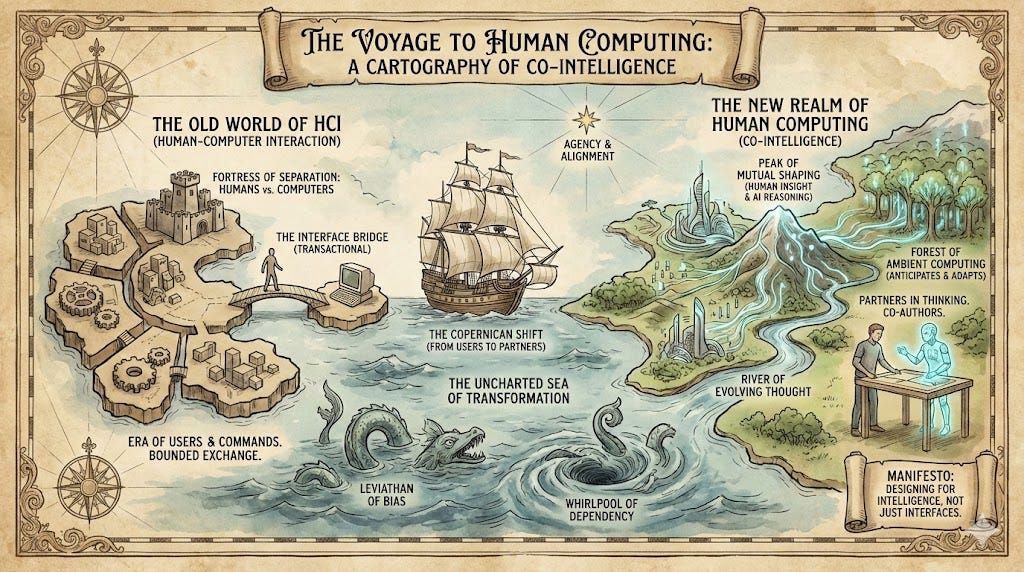
This is admittedly a little corny, but it’s impressive what Gemini was able to pull out.
Here also is the summary it created. Gemini over-indexed on the ghost metaphor a bit, but it did a good job of summarizing the main themes.
I. The great divide: a paradigm shift
The series centers on a fundamental transition in digital experience, comparing it to the move from Command Line to GUI.
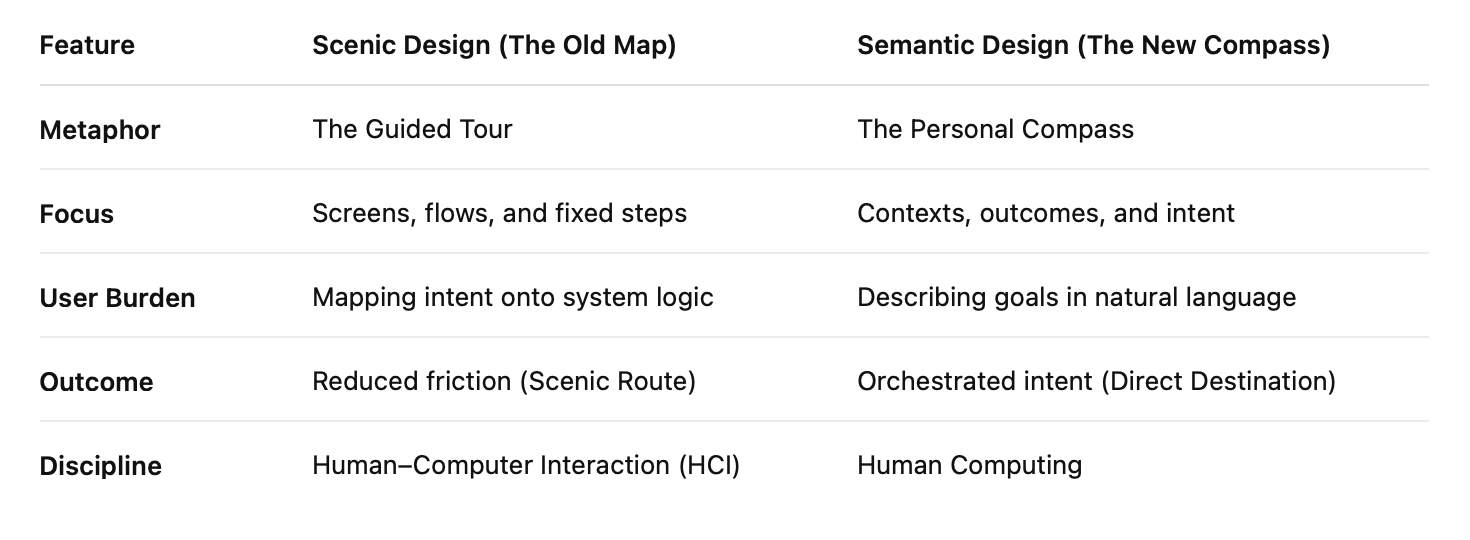
II. The three pillars of human computing
The “semantic territory” is defined by three evolutionary axes:
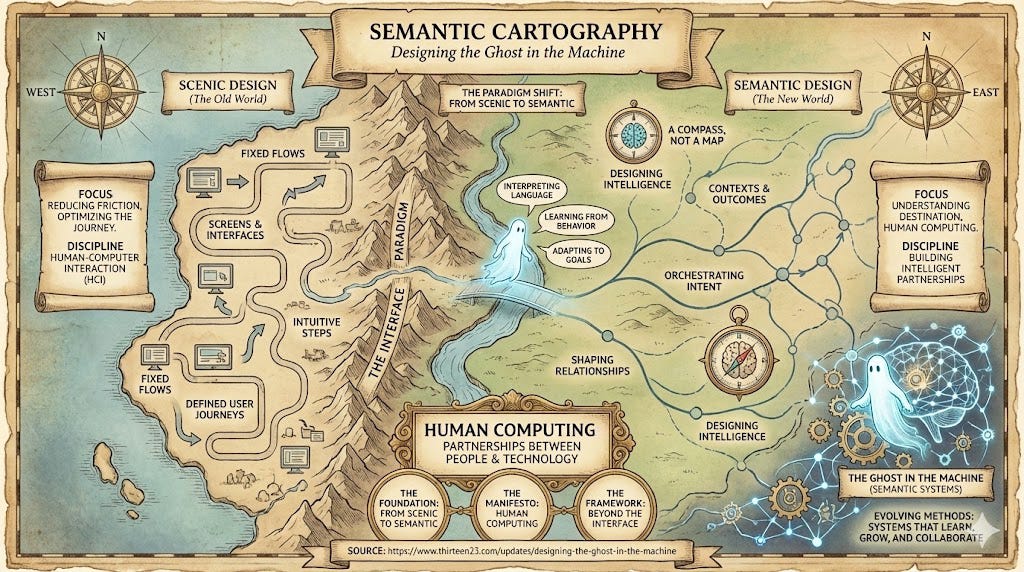
From commands → context
Old world: Explicit buttons and manual triggers.
New world: Systems that infer intent from behavior and environment.
From fixed → fluid
Old world: Pre-scripted journeys and rigid paths.
New world: Generative, personalized paths that adapt in real-time.
From tools → partnerships
Old world: Reactive execution of tasks.
New world: Collaborative co-intelligence that grows with the user.
III. The terrain of challenges
Moving into the “semantic” requires navigating high-risk zones where the “Ghost” (the AI) meets the “Machine” (the code).
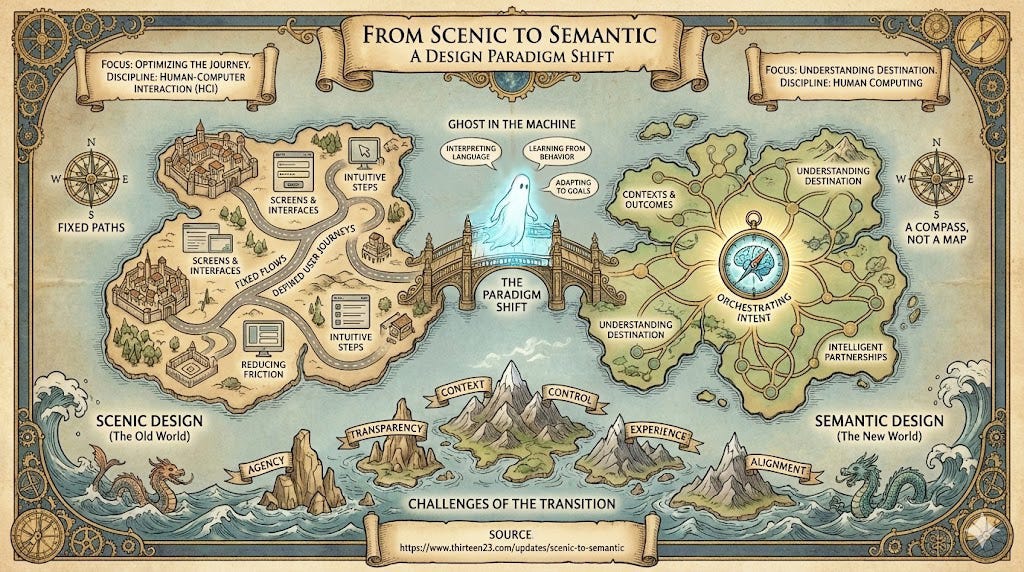
Agency vs. automation: Preventing user dependency; ensuring the human stays in the driver’s seat.
Transparent reasoning: Moving away from “Black Box” AI to “Glass Box” systems that explain why they made a choice.
The experience gap: How to maintain brand “soul” and emotional engagement when interfaces become ephemeral or invisible.
Alignment & ethics: Ensuring the system optimizes for human values, not just binary metrics.
IV. The designer’s new compass
To map this new world, designers must adopt a new set of instruments.
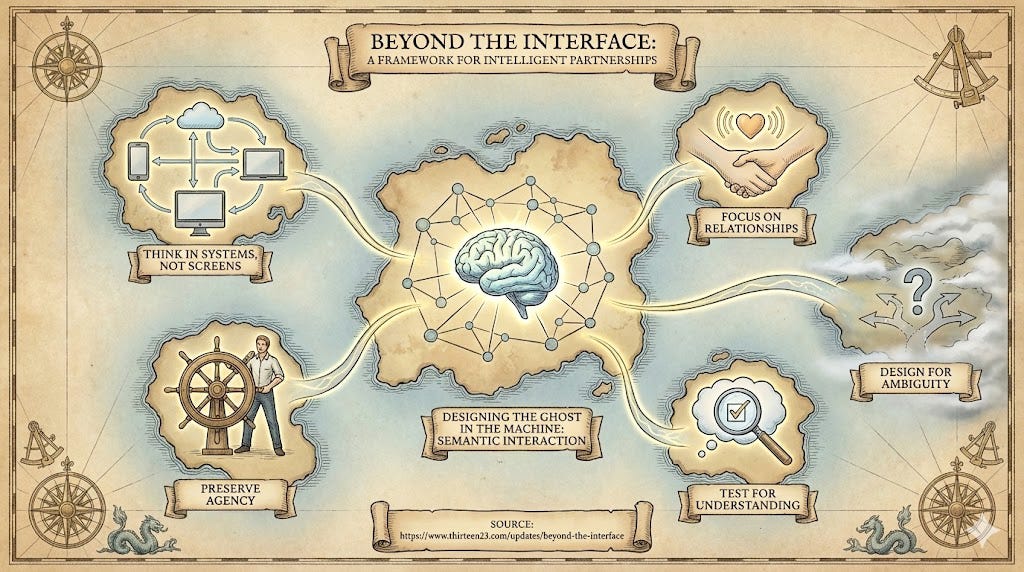
Think in systems, not screens: Interaction is distributed across time and devices.
Relationship design: Treat the interface as a thinking companion.
Design for ambiguity: Build guardrails for when the system “misunderstands” or faces nuance.
Test for alignment: Don’t just ask “Can they click it?”; ask “Does the machine understand the goal?”
The “ghost” summary
“We are shifting from designing interfaces to orchestrating intent.”
The “Ghost in the Machine” is not a spirit to be feared, but a Semantic Layer—a bridge of meaning that allows technology to finally speak the language of human purpose. The map concludes that the future of design isn’t about what people see, but how systems interpret and respond.
This piece really made me think. Your semantic cartography concept is brilliant, such an insightful way to frame this paradigm shift. I'm especially curious about ensuring the human stays in the drivers seat when systems infer intent. It's a really complex challenge for designers and educators.